

ChHeader

Overview
Edit request and response headers, organize profiles, and target specific sites to test APIs and websites.
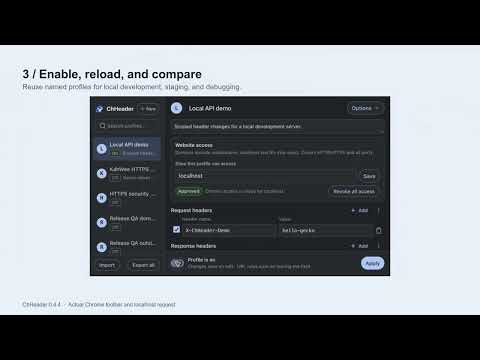
Edit HTTP request and response headers in Chrome for API testing, local development, and debugging. ChHeader keeps reusable profiles on your device, with no ads, analytics, or account required. TEST THE REQUEST YOU MEANT TO SEND • Add a custom request header to test a development API or trace a request. • Override a response header to check browser behavior on a site you control. • Keep separate profiles for local development, staging, and debugging. • Limit changes by site, URL pattern, regular expression, and request type—including documents and XHR/fetch. REUSABLE PROFILES, CLEAR CONTROLS Give profiles names, colors, and notes. Edit request and response headers together, switch individual headers on or off, and see which profile is active. Only one profile runs at a time; selecting a profile for editing does not enable it. Import and export JSON to reuse a setup. Imports receive new IDs and start off. Exports hide common credential header values by default; review custom values, notes, and URLs before sharing. Light and dark appearances follow your system setting. TRY IT WITH DEMO DATA 1. Create a profile and save the hostname you want to test under Website access. 2. Choose Approve sites to grant Chrome access, then reopen the popup if Chrome closes it. 3. Add your header and a URL rule, then turn the profile on. 4. Reload the page or send a new request. Switch the profile off to compare. A profile without URL rules changes no requests. Try the public header tester at https://headers.kahwee.com with demo values only, or use the localhost fixture in the source repository. YOUR SITES, YOUR SETTINGS Profiles are stored in Chrome's local extension storage, not Chrome Sync. ChHeader has no developer-operated collection service, advertising, analytics, or remotely loaded code. Request header values are sent to the destinations matched by your enabled rules. Local storage is not encrypted by ChHeader and is not a password manager. Website access is optional. ChHeader asks for the sites you choose; it does not request all-site access when you install it. Domain grants cover subdomains, HTTP/HTTPS, and all ports. URL rules narrow which requests change. For a page calling an API on another hostname, approve both the page and API hosts, then target the API with a URL rule. Turning a profile off stops header changes but keeps its site grants. Use Revoke all website access to remove grants and turn profiles off. Extension updates reset grants and turn profiles off while preserving your saved profiles. WHY THESE PERMISSIONS? • storage: save profiles and settings locally. • declarativeNetRequestWithHostAccess: let Chrome apply your header rules to approved sites. • Optional HTTP/HTTPS website access: support the development servers and APIs you choose. Built by KahWee Teng. Open source and available for inspection. Source and setup: https://github.com/kahwee/ch-header Privacy: https://github.com/kahwee/ch-header/blob/main/PRIVACY.md Support: https://github.com/kahwee/ch-header/issues
0 out of 5No ratings
Details
- Version0.4.4
- UpdatedSeptember 23, 2026
- Offered bytengkahwee
- Size879KiB
- LanguagesEnglish
- Developer
Email
kahwee@me.com - Non-traderThis developer has not identified itself as a trader. For consumers in the European Union, please note that consumer rights do not apply to contracts between you and this developer.
Privacy

ChHeader has disclosed the following information regarding the collection and usage of your data. More detailed information can be found in the developer's privacy policy.
ChHeader handles the following:
This developer declares that your data is
- Not being sold to third parties, outside of the approved use cases
- Not being used or transferred for purposes that are unrelated to the item's core functionality
- Not being used or transferred to determine creditworthiness or for lending purposes
Support
For help with questions, suggestions, or problems, please open this page on your desktop browser