

Enterprise Authentication & NetLog Inspector
5 ratings
)
Overview
Troubleshoot enterprise SSO and federation failures with live DevTools capture, offline HAR viewing, and Chromium NetLog analysis.
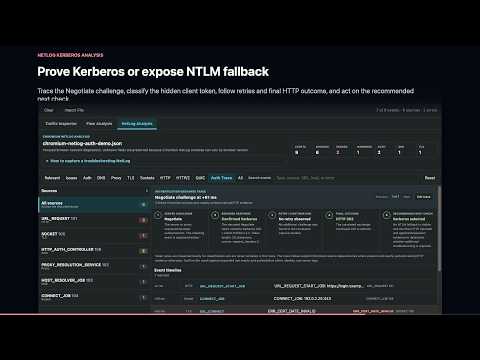
Enterprise Authentication & NetLog Inspector helps identity, application, and support engineers troubleshoot enterprise SSO and federation failures. It combines live Chrome DevTools capture with a standalone Offline Viewer for HAR and Chromium NetLog files. Live inspection is limited to the tab actively selected in Chrome DevTools while DevTools is open. The extension does not install content scripts across websites, request host permissions, or transmit captured information. Offline Viewer processes only files explicitly selected by the user. Use the Traffic Inspector to follow requests, responses, redirects, headers, cookies, timing, and content size from the first protected resource to the final application return. Flow Analysis groups related exchanges into authentication attempts, identifies incomplete transitions, and keeps each conclusion linked to the supporting request evidence. For federation troubleshooting, the inspector detects and decodes SAML requests and responses, then summarizes issuer, destination, assertion, condition, signature, attribute, and certificate evidence. For application authorization, it correlates OAuth 2.0 and OpenID Connect (OIDC) redirects, callbacks, token claims, state, nonce, PKCE, issuer, audience, and expiration signals. For access-management deployments, it recognizes Oracle Access Manager (OAM) and WebGate requests, cookies, redirects, request identifiers, and ECIDs. It also surfaces browser-visible errors and correlation identifiers associated with Okta and Microsoft Entra ID. For integrated Windows authentication, it follows Kerberos/WNA and NTLM challenge exchanges, retries, fallback behavior, and final HTTP outcomes. Forwarded X.509 client-certificate details are displayed when present in browser-visible headers. The Offline Viewer opens from the extension toolbar in a normal browser tab. It accepts HAR files, Inspector exports, SAML-tracer JSON, and Chromium NetLog captures, so an engineer can review customer evidence without first navigating to a website or opening DevTools. Imported data uses the same request and flow views as a live capture. NetLog Analysis organizes low-level Chromium events into focused findings. Engineers can trace an HTTP authentication exchange, review connection and certificate failures, follow related DNS or proxy events, and inspect the underlying source timeline. Where the capture contains sufficient client-token evidence, the inspector distinguishes Kerberos from NTLM fallback without displaying reusable token values. Additional capabilities include content search, protocol filters, static-resource suppression, slow-request emphasis, formatted request and response tables, and exportable Markdown assessments. Reports are available in sanitized and full-diagnostic forms for different support situations. All processing runs locally inside the extension. Captured traffic and imported files are not sent to the developer or third parties. Diagnostic files can contain sensitive information, so users should protect them and use sanitized exports when full values are unnecessary. The extension analyzes only evidence visible to the browser. It does not capture backend exchanges, domain-controller traffic, private keys, or server logs, and it does not perform cryptographic trust validation. Product website: https://ksudhir.github.io/oracle-sso-devtools/ Support and source code: https://github.com/ksudhir/oracle-sso-devtools Created by Sudhir Kulkarni
5 out of 55 ratings
Details
- Version5.1.2
- UpdatedAugust 29, 2026
- Offered bysudhir.kulkarni
- Size136KiB
- LanguagesEnglish (United States)
- Developer
Email
ksudhir@gmail.com - Non-traderThis developer has not identified itself as a trader. For consumers in the European Union, please note that consumer rights do not apply to contracts between you and this developer.
Privacy

This developer declares that your data is
- Not being sold to third parties, outside of the approved use cases
- Not being used or transferred for purposes that are unrelated to the item's core functionality
- Not being used or transferred to determine creditworthiness or for lending purposes
Support
For help with questions, suggestions, or problems, visit the developer's support site