

TradingView Journal Clipper
1 rating
)
Overview
Clip trades from TradingView charts to your journal (Markdown + HTML table + chart screenshot)
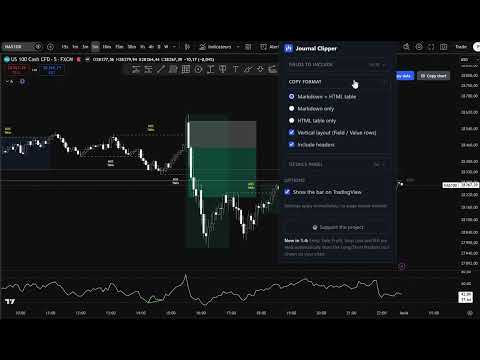
Log your TradingView trades in one click — without breaking your focus. If you keep a trading journal in Notion, Obsidian, Excel or Google Sheets, this extension does the tedious part for you. No more screenshotting, cropping, and retyping price levels by hand. WHAT IT COPIES A small bar sits on your chart with two buttons. Copy data gives you a ready-to-paste table: date, time, day of the week, ticker, timeframe, and trading session (Asia / London / New York, detected automatically). Before copying, a quick panel lets you add your bias, your mood, whether you followed your plan, your setup, and a short note — one click each. Copy chart puts a full-resolution PNG of your chart on the clipboard, ready to paste straight into Notion. IT READS YOUR POSITION TOOL Draw a Long or Short Position tool on your chart and the extension reads it directly: side, entry price, take profit, stop loss, and risk/reward ratio — the exact values from your drawing, not a guess. They show up in the panel before you copy, so you can check everything at a glance. BUILT FOR YOUR JOURNAL By default you get one row with the fields as columns, which drops cleanly into an existing Notion database. Prefer the classic two-column table? One checkbox. Need raw values with no headers? Another checkbox. Markdown, HTML table, or both — your choice. You pick which fields to include. HOW IT WORKS Open a chart on TradingView. Optional: draw your Long/Short Position tool. Click "Copy data" on the bar, or press Ctrl+Shift+L. Paste into your journal. Then "Copy chart" (Ctrl+Shift+K) for the screenshot. The bar can be dragged anywhere, collapsed, or hidden entirely if you prefer the keyboard shortcuts. YOUR DATA STAYS YOURS No account, no server, no tracking. Everything runs in your browser and nothing ever leaves it. Your settings are stored locally. Note: the extension reads TradingView's interface, which they update from time to time. If a field ever comes back empty, everything else keeps working. Like it? There's a "support the project" link inside the extension. Completely optional — it helps fund updates and maintenance.
5 out of 51 rating
Details
- Version1.5.0
- UpdatedAugust 3, 2026
- Offered byLucas
- Size36.59KiB
- LanguagesEnglish
- DeveloperLuca
1 Rue Marguerin Paris 75014 FREmail
mathtesting.pro@gmail.com - Non-traderThis developer has not identified itself as a trader. For consumers in the European Union, please note that consumer rights do not apply to contracts between you and this developer.
Privacy

This developer declares that your data is
- Not being sold to third parties, outside of the approved use cases
- Not being used or transferred for purposes that are unrelated to the item's core functionality
- Not being used or transferred to determine creditworthiness or for lending purposes