

Redline

Overview
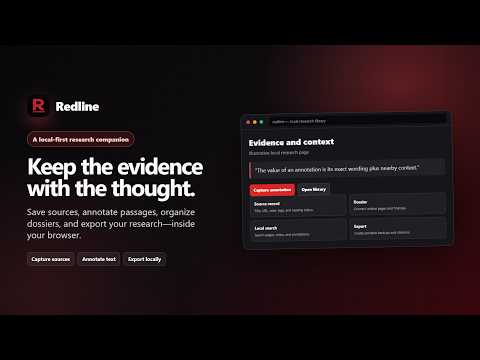
Annotate the web. Keep the evidence. Local annotations for serious reading.
Redline is a local-first research companion for people who need to keep the evidence with the thought. Save web pages as structured source records, capture selected passages as annotations, group related material into dossiers, and search your research library without sending it to a hosted Redline service. Use Redline while reading to save the current page with a title, note, tags, reading status, importance, and optional dossier links. Select text to capture a highlight, claim, source, question, follow-up, or other research annotation. Saved highlights can be restored on compatible pages when their text can still be located. In the library, review pages, annotations, dossiers, tags, and links together. The Evidence Compiler turns dossier questions into reviewable claims: connect exact saved passages as supporting, challenging, or contextual evidence, record a conclusion and rationale, and use deterministic checks to find unsupported claims, contradictions, missing evidence, or passages that need review. These checks identify evidence gaps; they do not score truth or source credibility. Source Witness lets you explicitly preserve normalized readable text for a saved source in the local vault. In the sidebar, use **Preview capture** to review the content and estimated size, then **Preserve capture** to retain it. Repeat those controls on a later source version, then choose **Open capture history** to inspect focused changes, verify the stored text against its SHA-256 digest, read it offline, and see when a changed block affects an annotation or claim. The digest verifies only the stored normalized text; it does not prove source truth, authorship, capture time, completeness, immutability, or legal admissibility. To move beyond an existing bookmark collection, import a standard Chrome-family/Netscape bookmarks HTML export or Firefox Bookmark Backup JSON. Supported URLs become Pages, full bookmark-folder paths become dossier names, and a local preview reports new records, duplicate URLs, and unsupported URLs before anything changes. Redline can also restore its full-fidelity **All data** JSON backups and generate local exports in JSON, CSV, XML, Markdown, BibTeX, RIS, CSL JSON, EndNote XML, bibliography, and academic Markdown formats. Claims and evidence relationships are included in Redline backups and supported evidence-aware exports. Key benefits - Keep web sources with notes and research context. - Turn an existing browser bookmark collection into Redline Pages and dossiers. - Capture passages while you read instead of losing them in bookmarks. - Organize work with tags and dossiers. - Compile dossier claims from exact supporting, challenging, and contextual passages. - Preserve readable source versions locally and review focused changes that affect saved evidence. - Review deterministic evidence-gap checks without truth or credibility scoring. - Search your locally stored sources, notes, and annotations. - Create portable backups and citation-friendly exports. How it works 1. Open Redline from the toolbar, context menu, or keyboard shortcuts. 2. Save a page, capture selected text, or migrate browser bookmarks from the Library. 3. Add notes, tags, status, importance, or a dossier. 4. In the sidebar, choose **Preview capture** and then **Preserve capture** whenever you intentionally preserve a readable source version; choose **Open capture history** to review the resulting comparison. 5. Create dossier claims and connect saved annotations from the Evidence view. 6. Review, search, and export your local vault from the library. Supported browsers and platforms Built for current desktop Chrome, Chromium, Microsoft Edge, and Brave through the Chrome Web Store. Redline has a separate Firefox build for AMO; see the Firefox listing materials. Limitations - Annotation restoration depends on the original text and nearby context remaining on the page. Heavily dynamic or rewritten pages can require review. - Source Witness stores normalized readable text, not scripts, styles, forms, login state, third-party assets, every network response, or a pixel-perfect page archive. Protected and application-like pages can be unavailable or incomplete. - Page interaction is unavailable on browser-internal and other protected pages. - Redline stores its vault in browser-managed local storage. Clearing browser profile/extension data can remove it unless it has been exported. - Browser-bookmark migration accepts standard Chrome-family/Netscape HTML exports and Firefox Bookmark Backup JSON files. It imports HTTP and HTTPS entries, skips existing and unsupported URLs, and represents nested folder paths as flat dossier names. - CSV export writes a locally generated ZIP containing separate CSV files.
0 out of 5No ratings
Details
- Version1.0.3
- UpdatedJuly 16, 2026
- Offered byTheAnarchoX
- Size169KiB
- LanguagesEnglish
- Developer
Email
theanarchox@proton.me - Non-traderThis developer has not identified itself as a trader. For consumers in the European Union, please note that consumer rights do not apply to contracts between you and this developer.
Privacy

Redline has disclosed the following information regarding the collection and usage of your data. More detailed information can be found in the developer's privacy policy.
Redline handles the following:
This developer declares that your data is
- Not being sold to third parties, outside of the approved use cases
- Not being used or transferred for purposes that are unrelated to the item's core functionality
- Not being used or transferred to determine creditworthiness or for lending purposes
Support
For help with questions, suggestions, or problems, please open this page on your desktop browser