

Shipwork SEO check

Overview
Preview page signals, then run a server-checked site audit with your Shipwork allowance.
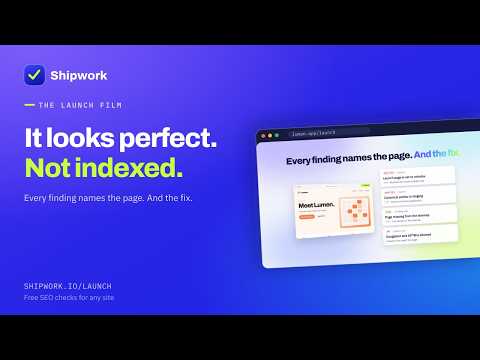
Shipwork is a Chrome SEO page inspector for people who manage websites. Open the extension on any public page to see two prioritized on-page signals and a clear next step, without sending the page's content anywhere. When you want a deeper look, one click runs a real, server-backed site audit using your free monthly Shipwork allowance. WHAT THE LOCAL PREVIEW CHECKS The moment you open the popup, Shipwork reads the page's own markup, entirely in your browser: - Title tag and meta description, including length and whether they look generic or missing - Canonical URL, so you can see what the page is telling search engines to index - Robots meta directive (index/noindex, follow/nofollow) - Heading structure (H1 and how headings are nested) - Hreflang language and region links - Structured data (JSON-LD) types present on the page - Open Graph and social preview tags - Image alt attributes - The document's declared language Rather than flagging every minor variation as an "error," the popup surfaces the two signals that matter most for that specific page, and explains why. When a title is missing or too generic, Shipwork can suggest a more specific one drawn from the page's own heading, so the fix is concrete instead of a vague warning. WHAT THE FREE SITE AUDIT ADDS A single page can't tell you everything a search engine sees across a whole site. Choosing "Use my free site check" sends the current page's public URL to Shipwork's servers for a wider audit that a browser tab alone cannot run, including: - Crawl access: whether robots.txt or a stray noindex is blocking pages that should be indexed - Sitemap presence and whether it lists the pages that actually exist - Internal linking: pages with too few internal links, and orphan pages with none - Canonical tag consistency across the site, not just one page - Indexing signals that line up with what Google Search Console reports (indexed, discovered but not indexed, crawled but not indexed, duplicate content with a different canonical chosen by Google) - Structured data coverage against what rich results expect The popup shows a short, prioritized preview of that audit and links out to the full saved report on Shipwork, where sign-in, credits and paid plans unlock deeper detail. The free allowance resets monthly and is shared with the website, so using the extension doesn't create a separate quota. WHO THIS IS FOR Shipwork SEO check is built for site owners, in-house marketers, SEO freelancers and agency teams who need a fast read on a page's SEO health while they're already looking at it, whether that page is on Shopify, WordPress, Webflow, a custom stack, or anything else Chrome can render. It's a companion to Google Search Console, not a replacement: Search Console tells you what Google has already seen; Shipwork checks what's on the page and what a wider crawl would find right now, including issues Search Console won't show until its next crawl. WHEN CHROME BLOCKS INSPECTION Some pages, like Chrome's internal settings pages or the Chrome Web Store itself, can't be inspected by any extension. On those pages, Shipwork explains the limit plainly and offers a field where you can type a public website address to open its audit on shipwork.io instead, with the URL already filled in. Opening that page never spends a check by itself; a check only runs once you start it on the site. FREQUENTLY ASKED QUESTIONS Does this extension send my page content anywhere? No. The on-page preview (title, meta description, canonical, robots directive, headings, hreflang, structured data, Open Graph tags, image alt text, document language) is read and shown entirely in your browser. Nothing about the page's content leaves your device unless you explicitly choose "Use my free site check," which sends only the current page's URL to Shipwork's servers. Is Shipwork SEO check free? Yes. The on-page preview is always free and unlimited. The deeper site audit uses Shipwork's shared monthly free allowance; sign-in, credits and paid plans for more checks or deeper reports are handled on shipwork.io, not inside the extension. What is a canonical tag, and why does the extension check it? A canonical tag tells search engines which URL is the "master" version of a page when duplicate or near-duplicate URLs exist (for example, with and without tracking parameters). A missing, incorrect, or self-conflicting canonical can cause search engines to index the wrong URL, split ranking signals, or ignore your preferred page entirely. Shipwork reads the canonical on the open page instantly, and checks canonical consistency across the whole site during a full audit. What does a missing or generic meta description mean for SEO? The meta description doesn't directly affect rankings, but it strongly influences whether people click your result in search. A missing or duplicated description often means a generic or truncated snippet in the results page. Shipwork flags this and, for titles, can suggest a more specific one based on the page's own content. What does "noindex" or a blocked robots directive mean? If a page carries a noindex meta tag, or robots.txt disallows crawling, search engines won't include it in results even if it has good content and backlinks. This is one of the most common reasons a page a site owner expects to rank never shows up. Shipwork checks the robots directive on the open page and, during a full audit, checks robots.txt and crawl access across the site. What are orphan pages, and why do they hurt SEO? An orphan page has no internal links pointing to it from anywhere else on the site, which makes it harder for both users and search engine crawlers to discover, even if it's in the sitemap. Shipwork's site audit checks internal linking and flags pages with too few or zero inbound internal links. What is structured data (schema markup), and does Shipwork check it? Structured data (commonly JSON-LD) is machine-readable markup that helps search engines understand what's on a page, such as a product, an article, a recipe, or an FAQ, and can unlock rich results like star ratings or price ranges in search. The on-page preview reads which structured data types are present; the full audit checks structured data coverage against what rich results actually require. How is Shipwork different from Google Search Console? Search Console reports what Google has already crawled and indexed, often with a delay. Shipwork inspects what's on the page and site right now, so it can catch problems (a new noindex tag, a broken canonical, a page that fell out of internal links) before or independent of Google's next crawl. Many site owners use both together. Does Shipwork work on Shopify and WordPress sites? Yes. Shipwork checks the rendered page markup, so it works on any platform Chrome can display, including Shopify, WordPress, Webflow, Wix, Squarespace and custom-built sites. The extension has no platform-specific requirements. What happens to the data from a site audit? The server-side audit result is saved as a report on your Shipwork account (or as an anonymous report tied to the check, depending on sign-in) so you can reopen it later. The extension itself only keeps a short local preview of that result in Chrome's local extension storage, so it's still visible after you close the popup. Do I need an account to use the extension? No account is required for the local page preview or to view the free site check's preview result. Signing in on shipwork.io is only needed to save full reports to an account, purchase credits, or access paid plans. BEYOND THE EXTENSION Shipwork's website hosts a broader catalog of website tools beyond what runs inside the extension, covering areas like technical SEO and on-page checks, sitemap and indexing diagnostics, structured data validation, ecommerce product feed checks, AI crawler and llms.txt access, trust and security signals (SSL, DNS, email security), page speed and Core Web Vitals, and search performance data drawn from Search Console. Some of those tools or results may require sign-in, credits or a plan; the current list is on shipwork.io. PRIVACY The local page preview stays entirely in your browser and is never transmitted. When you choose a site audit, only the current page's URL is sent to Shipwork, where the report is generated and saved so you can reopen it later. The extension keeps a short local copy of that result's preview in Chrome's local extension storage so it survives closing the popup. See shipwork.io/privacy for full retention details. Shipwork does not promise search rankings, guaranteed indexing, or that every possible site issue will be found; it reports observable signals so you can make an informed decision about what to fix next.
0 out of 5No ratings
Details
- Version1.1.0
- UpdatedSeptember 29, 2026
- Offered byzicoaamerdev
- Size111KiB
- LanguagesEnglish
- Developer
Email
genounTech@gmail.com - Non-traderThis developer has not identified itself as a trader. For consumers in the European Union, please note that consumer rights do not apply to contracts between you and this developer.
Privacy
Shipwork SEO check has disclosed the following information regarding the collection and usage of your data. More detailed information can be found in the developer's privacy policy.
Shipwork SEO check handles the following:
This developer declares that your data is
- Not being sold to third parties, outside of the approved use cases
- Not being used or transferred for purposes that are unrelated to the item's core functionality
- Not being used or transferred to determine creditworthiness or for lending purposes
Support
For help with questions, suggestions, or problems, please open this page on your desktop browser