

LYNC Threat Radar Pro

Overview
Local real-time threat and credential leak detection.
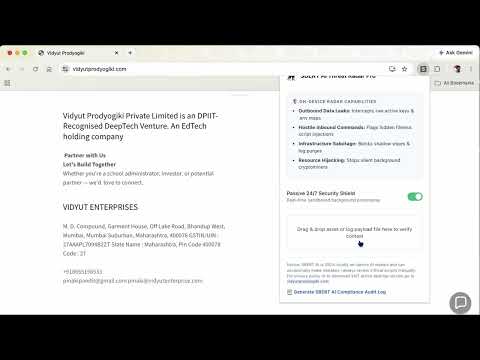
🎯 LYNC Threat Radar Pro: Enterprise-Grade Viewport Infrastructure Protection & Zero-Egress On-Device Stream Auditing LYNC Threat Radar Pro (v1.0.9) introduces an advanced, completely local data isolation layer designed to bring real-time, zero-latency security intelligence straight into your browser's viewport boundary. Engineered specifically for security engineers, DevOps personnel, cloud architects, database administrators, and enterprise compliance officers, this extension acts as a protective shield against unintended corporate data leaks, fileless shell injections, administrative tampering, and active cryptojacking stagers. By combining high-speed deterministic heuristics with a local Machine Learning architecture—leveraging an on-device fine-tuned Scikit-Learn Random Forest, high speed, meta-classifier head. LYNC Threat Radar Pro scans files, development scripts, environmental profiles, and system log inputs with absolute privacy. No background telemetry trackers, no phone-home servers, no outbound API communication pipelines, and no remote cloud system dependencies—Zero External Network Egress. 100% On-Device Computational Isolation. 🎯 CORE SECURITY SCANNING VECTOR MODULES LYNC Threat Radar Pro acts as an on-device deep-inspection firewall node. It leverages a high-speed parsing canvas to intercept, audit, and flag hidden risk signatures across four critical infrastructure protection vector modules before payloads can escape your host system boundary: 1️⃣ Outbound Data Leak Prevention & Cryptographic Exfiltration Shield Accidental data exposure caused by copying, pasting, or dragging files into web applications is a leading cause of enterprise cloud security failures. LYNC Threat Radar Pro continuously scans text stream transactions within its isolated sandbox zone to capture accidental leaks of sensitive access keys and credentials. • Advanced Credential Interception: The core matching engine flags exposed private cryptographic profiles (such as root OpenSSH private keys), raw production database connection strings (DATABASE_URL handles), localized cloud environment configurations (.env profiles), infrastructure-as-code (IaC) templates, and active developer API tokens. • Verified Dataset Coverage: This module is explicitly calibrated to isolate raw environmental configuration leaks and active JWT session authorization tokens. It successfully triggers a CREDENTIAL_LEAK_BLOCK alert at a good confidence index threshold. 2️⃣ Hostile Inbound Interception & Reverse-Shell Analysis Engine Modern adversaries avoid dropping traditional compiled files onto a workstation's storage disk, opting instead to execute live malicious commands directly inside memory via native system command-lines. LYNC Threat Radar Pro audits text buffers to catch fileless, memory-only stagers, unauthorized background shell initialization blocks, or interactive reverse backdoors hidden behind standard communication protocols. • Shell Spawning & Obfuscation Interception: It identifies network socket redirections (such as /dev/tcp or /dev/udp streams), interactive terminal configurations (bash -i, zsh -i), netcat backdoor stagers (nc -e), and advanced script download methods (PowerShell DownloadString or IEX execution loops). • Verified Dataset Coverage: Engineered to intercept standard and obfuscated PowerShell/Unix stagers, this engine successfully processes hidden interactive vectors, flagging administrative script attempts with a TERMINAL_MALWARE_REVERSE_SHELL trigger alert at a up to 98.5% confidence index threshold. 3️⃣ Infrastructure Sabotage Shield & Log-Clearing Defense Protect your localized processing environments from destructive dependency files, code injection vectors, and administrative tampering scripts. LYNC Threat Radar Pro monitors incoming workspace data strings for malicious commands designed to silently blind or disable endpoint defense tracing layers. • Ransomware & System Defeat Isolation: The scanning core dynamically flags attempts to systematically delete volume shadow backups (vssadmin delete shadows), disable boot failure recovery settings (bootstatuspolicy), wipe critical administrative event logs (wevtutil cl), stop essential security daemons, or execute hazardous directory operations (rm -rf /). • Verified Dataset Coverage: This module actively captures critical ransomware stager sequences—such as bcdedit /set ... or wbadmin delete catalog ... routines designed to drop system recovery metrics. It also identifies standard script injection strings, base64 payload configurations, and classic SQL Injection tautologies wrapped in single-quote bypass delimiters (e.g., a = "1' OR '1'='1"), triggering a REMOTE_PAYLOAD_INJECTION block at a up to 99.7% confidence index threshold. 4️⃣ Resource Hijacking Prevention & Automated Data Scraping Guard Malicious background cryptocurrency miners can silently degrade workstation performance, lag interface renderings, and drive up enterprise cloud processing costs. LYNC Threat Radar Pro scans incoming code blocks and log metrics to identify known cryptojacking stagers protocols and configurations before they establish execution anchors. • Cryptojacking & Bot Mitigation: The tool maps Stratum mining connection parameters, public privacy-coin mining pool endpoints, automated DOM-harvesting data scrapers (document.querySelectorAll, MutationObserver intercepts), and native miner binary properties (xmrig, cpuminer references), keeping your browser tabs fast and your local processor cool. • Verified Dataset Coverage: Calibrated against complex obfuscated configurations, this layer features unique wild-card path boundaries that catch double-delimiter connection anomalies (such as stratum+tcp://://supportxmr.com pool profiles) as well as headless browser automation arrays (puppeteer, playwright), throwing a rapid ANTI_SCRAPING_VIOLATION intercept alert at a up to 99.2% confidence index threshold. ⚡ TECHNICAL HIGH-PERFORMANCE ENGINE & PRIVILEGE ISOLATION PROTOCOLS • Dual-Stage Local Machine Learning Framework: LYNC Threat Radar Pro integrates a highly efficient, client-side ML execution loop running entirely via ONNX Runtime Web. Plaintext data blocks are compiled into contextual matrices by a frozen, lightweight 33MB ALBERT transformer core, then passed directly into a specialized, fine-tuned Scikit-Learn Random Forest classifier head. The system processes and scores structural vectors in under 35 milliseconds per window without lagging your user interface canvas. • Air-Gapped Heuristic Fallback Gate: In compliance with strict sandboxing policies, any standard non-malicious log file or administrative layout (such as CAPTCHA.rtf documentation) safely maps through the engine's clean baseline fallback route, registering a verified SYSTEM_COMPLIANCE_PASS at a stable 100.0% confidence index score anchored to a calibrated 5.1000 logit matrix base. • Verified Minimalist Permissions Model: In alignment with Google's Principle of Least Privilege and Chrome Web Store privacy practices, LYNC Threat Radar Pro requests zero global host permissions (<all_urls>). Its web-accessible resources are locked strictly down to its own client environment boundaries ("chrome-extension://*/*"). The extension cannot read external web browsing history, cannot interact with third-party web domains, cannot manipulate active session cookies, and completely lacks the network privileges required to transmit data outside your local machine. ⚠️ SYSTEM COMPLIANCE NOTICE & TRANS-REGULATORY PEER GROUNDING Notice: Extension environment constraints limit on-device parameter size. Models can occasionally make mistakes. For our privacy policy parameters or to review our more capable enterprise desktop installations, fully local API implementations, or custom integration products, contact us at vidyutprodyogiki.com. LYNC Threat Radar Pro is built exclusively to function as a real-time, client-side safety verification layer. Because adversarial attack methods and infrastructure configurations change rapidly across international spaces, edge verification tools should be used as a helpful early-warning indicator—always verify enterprise script deployments manually. To maintain absolute professional transparency and trust within the developer community, the extension's entire source code, processing layers, and manifest structures are completely open for public security peer review.
0 out of 5No ratings
Details
- Version1.0.9
- UpdatedNovember 13, 2026
- Offered byVidyut Prodyogiki
- Size363KiB
- LanguagesEnglish
- DeveloperVidyut Prodyogiki Pvt. Ltd.
Om Manusmruti Hsg Society, Dongri Pada, GB road. B-504 Thane, Maharashtra 400615 INEmail
pinakipandit@gmail.comPhone
+91 98922 38533 - TraderThis developer has identified itself as a trader per the definition from the European Union and committed to only offer products or services that comply with EU laws.
Privacy

This developer declares that your data is
- Not being sold to third parties, outside of the approved use cases
- Not being used or transferred for purposes that are unrelated to the item's core functionality
- Not being used or transferred to determine creditworthiness or for lending purposes
Support
For help with questions, suggestions, or problems, please open this page on your desktop browser