


Overview
Checks the site you are on for an AI Catalog, MCP Server Card, llms.txt and WebMCP tools. Reads a site only when you click.
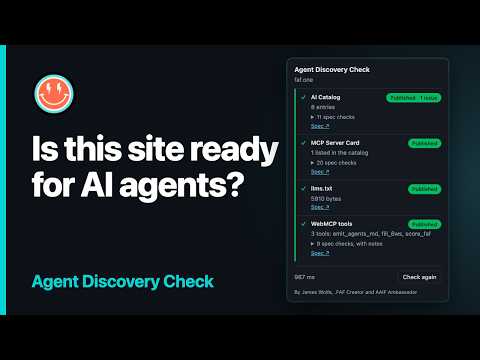
Agent Discovery Check tells you whether the website you are on publishes the files AI agents look for, checks them against their specs, and shows the spec behind every result. Use it on your own site to see what is missing, or on any other site to see how it is set up for AI agents. Click the icon on any site. You see one row per surface: • AI Catalog: /.well-known/ai-catalog.json • MCP Server Card: found by reading the catalog's entries • llms.txt • WebMCP tools: the tools the page registers for agents On a GitHub repository page it also checks, by presence, for: • AGENTS.md • project.faf Each WebMCP tool is checked against the WebMCP spec: its name, description and input schema. Where the spec can't yet express something (annotations on form tools), the extension says so as a note, not an error. Each row says Published, Not published, or Unreadable. When a catalog or Server Card is published, the row shows how many spec checks it failed, for example "Published · 2 issues". Open the row to see every check, tagged MUST or SHOULD, with a link to the spec it comes from. There is no score. A check that does not apply says Skipped, and a server that is down says Unreadable rather than Not published. PRIVACY The extension has no access to any site until you click it, and then only to that one tab. It requests /.well-known/ai-catalog.json and /llms.txt from the site you are on (on a GitHub repository page, also AGENTS.md and project.faf). When the site's AI Catalog lists an MCP Server Card, it requests that card and checks the catalog's links, up to 30 requests in all, plus any preflight request the browser sends to the card's host, only on the site itself and the card's host, which can be another site. It does not follow redirects. Every request is GET, HEAD or OPTIONS and carries no cookies; another host is told only the address of the site you clicked on. Results appear in the popup only. The extension stores nothing, sends nothing to FAF, and has no analytics. PREVIOUSLY STACK GRABBER This update changes what the extension does. It was Stack Grabber before this update; it is now Agent Discovery Check. Stack Grabber may have kept a log of its use in your browser; this version doesn't read it, and removing the extension deletes it. Free and open source. By James Wolfe, .FAF Creator and AAIF Ambassador. Source: https://github.com/Wolfe-Jam/faf-chrome-extension
5 out of 51 rating
Details
- Version2.0.1
- UpdatedOctober 23, 2026
- Size57.82KiB
- LanguagesEnglish
- DeveloperWebsite
Email
james@wolfejames.com - Non-traderThis developer has not identified itself as a trader. For consumers in the European Union, please note that consumer rights do not apply to contracts between you and this developer.
Privacy

Agent Discovery Check has disclosed the following information regarding the collection and usage of your data. More detailed information can be found in the developer's privacy policy.
Agent Discovery Check handles the following:
This developer declares that your data is
- Not being sold to third parties, outside of the approved use cases
- Not being used or transferred for purposes that are unrelated to the item's core functionality
- Not being used or transferred to determine creditworthiness or for lending purposes
Support
For help with questions, suggestions, or problems, please open this page on your desktop browser