

QAgentExt - QA Testing Agent

Overview
Run guided QA checks, failure triage and bug replay packs on web pages, and iOS app flows via Appium, from the Chrome side panel.
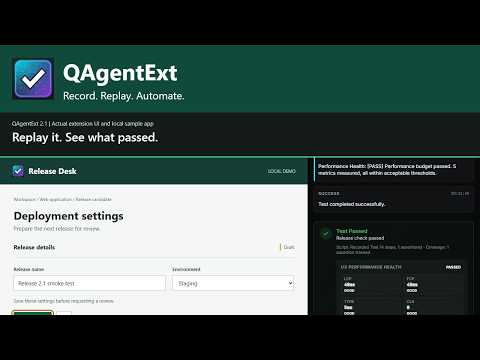
Record a browser flow. Replay it as a test. Export a starting point for automation. QAgentExt helps developers and QA testers turn everyday manual checks into reusable browser tests from the Chrome side panel. Start with a short flow on a page you are authorized to test, review the captured steps, and define what should happen before you replay it. RECORD -> REPLAY -> EXPORT Record your test Use Record while you interact with your web application. Stop recording to review the captured steps. Add an expected result, such as confirmation text appearing after a form is saved. Review inferred assertions rather than assuming a recorded click proves the feature works. Replay and understand the result Run the reviewed steps on your target page. Inspect the outcome, execution log and available failure details. Save useful tests to your library and replay them as your application changes. Export automation starter code Choose Playwright, Cypress or another available format and copy a generated script. Review the output, configure your target URL and test environment, and check unsupported actions before running it in your own automation project. Export coverage varies by action and framework; generated code may need edits and dependencies. Playwright and Cypress exports block execution when the test includes unsupported steps, so a partial export does not silently appear to pass. Implement and review those steps before removing the generated guard. TEST IPHONE AND IPAD APPS (PREVIEW) Install QAgentExt on a Mac that runs Appium, open the iOS tab in the side panel, and run a flow on an iOS simulator or a connected device. Test any app by its bundle id, or a website in mobile Safari. Write the flow as plain text, one step per line: launch app com.apple.Preferences tap "General" expect text "About" visible Steps include tap, type, swipe, scroll, long press, pinch, drag, switching into a web view, waiting for an element and checking text or values. Each step is shown live. A failure keeps a screenshot of the screen and the element tree, and the run downloads as JSON or JUnit XML. Problems in a flow are reported by line before anything touches the device. Secrets typed for a run are kept only while the panel is open and are never saved or exported. You install and start Appium yourself (free and open source; it needs Xcode on macOS). QAgentExt connects to the Appium address you enter, by default this Mac. The iOS tab is a preview: check results on your own devices before relying on them. GROW A REGRESSION LIBRARY Organize saved tests into suites and run regression checks sequentially. Use CSV data and environment profiles for repeated scenarios. Review pass, fail and flaky outcomes, retained failure evidence, and rerun selected failures. Retries are opt-in and should be used carefully for actions that change application data. TOOLS WHEN YOU NEED THEM - Author supported plain-language QA commands and explicit assertions. - Inspect failed steps and available console or network diagnostics. - Compare visual baselines after reviewing the intended reference. - Run accessibility, keyboard, contrast and screen-reader semantics checks. - Hover over elements for live contrast feedback; click to keep the final report. - Inspect screen-reader roles, names and states with pointer or keyboard navigation. - Test WCAG text spacing: a scanner rule applies the 1.4.12 values and reports text that clips or overlaps, and an editor lets you set line height, letter, word and paragraph spacing live, with a keyboard shortcut to toggle them on any page. - Test APIs and inspect supported response assertions. - Export reports and reproduction evidence after checking for sensitive data. - Install the companion CLI from qagentext.netlify.app/cli to run saved tests, regression plans and iOS flows in CI with the same engine. START SMALL Open a safe test page, open QAgentExt, and choose Record. Capture a short task, stop, review the steps and expected result, then replay it. Save the test and use Copy Script when you are ready to move toward code-based automation. IMPORTANT LIMITS Test actions can click, type, navigate and trigger application requests. Use dummy data or a safe test environment. Sequential runs share browser state; switching profiles does not automatically reset sessions, cookies, storage or backend data. Automated accessibility and security checks are diagnostic aids, not certification or a substitute for specialist and manual review. Screen-reader semantics checks do not reproduce a complete NVDA, JAWS or VoiceOver session. Browser-protected pages and some embedded content may not be testable. PRIVACY AND CONTROL Core test processing runs locally in Chrome and does not require a QAgent account. Test steps can send requests to the applications or API endpoints you choose. Optional monitor webhooks send configured summaries. The iOS tab sends commands to the Appium server address you enter, only when you check it or run a flow. The panel also loads web fonts. Recordings, saved tests, profiles, screenshots and reports may contain application data or credentials. Review and redact them before sharing or committing. Automatic masking does not guarantee that every secret has been removed.
0 out of 5No ratings
Details
- Version2.3.0
- UpdatedOctober 13, 2026
- Offered byShubham Singh
- Size466KiB
- LanguagesEnglish
- Developer
Email
shubix.connect@gmail.com - Non-traderThis developer has not identified itself as a trader. For consumers in the European Union, please note that consumer rights do not apply to contracts between you and this developer.
Privacy

This developer declares that your data is
- Not being sold to third parties, outside of the approved use cases
- Not being used or transferred for purposes that are unrelated to the item's core functionality
- Not being used or transferred to determine creditworthiness or for lending purposes
Support
For help with questions, suggestions, or problems, please open this page on your desktop browser