

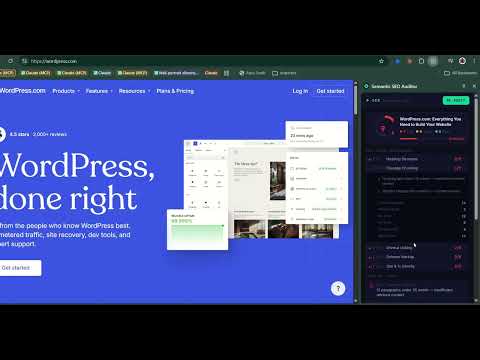
Overview
Instant rule-based SEO audit — heading structure, schema, links, passage chunking, stat density.
1. Product Taglines & Hook Primary Tagline: Auditing Content for the Semantic Search Era—Right in Your Browser. Secondary Tagline: Check heading structure, passage chunking, internal links, schema, and stat density side-by-side with your CMS. Elevator Pitch: Semantic SEO Auditor is a lightweight, privacy-focused Chrome Extension that sits in your browser side panel to analyze the semantic quality of your articles instantly. With a single click, it checks your content against 5 critical SEO dimensions, ensuring your structure is optimized for modern passage-retrieval algorithms, rich snippets, and credibility signals—all processed 100% locally. 2. The Problem It Solves Traditional SEO tools focus heavily on keywords, keyword density, and basic meta tags. However, modern search engines (like Google's RankBrain, BERT, and MUM) process content semantically. They look at: How well content is chunked for passage extraction (Passage Retrieval). Logical hierarchy of headings (not just random size adjustments). Factual credibility cues like statistical density. Semantic anchoring of internal links rather than generic "click here" calls to action. Structured schema data to verify E-E-A-T (Experience, Expertise, Authoritativeness, Trustworthiness). Semantic SEO Auditor bridges this gap, giving creators a rule-based check on these advanced dimensions while they write in their CMS. 3. Key Value Propositions CMS Side-by-Side Integration: Because it runs in Chrome’s native side panel, it remains open while you edit in WordPress, Shopify, Webflow, or Google Docs. You don't have to keep switching tabs. 100% Privacy & Security: No databases, no API calls, no third-party tracking, and no page data sent to external servers. Your content and drafts remain completely yours. Actionable and Diagnostic: Rather than giving vague scores, the auditor lists exact errors (e.g., “3 paragraphs exceed 120 words” or “H3 heading appears before H2”) so you can fix them immediately. One-Click Shareability: Persistent side panel view allows you to capture screenshots of audit metrics instantly to share with writing teams, clients, or keep for compliance records. 4. Feature Breakdown: The 5 Checked Dimensions The tool audits content across 5 primary rule-based dimensions (based on a total score of 25): 1. Heading Structure (D7) Analyzes how search engines read your page's outline. H1 Validation: Ensures there is exactly one H1 tag per page. Hierarchy Checker: Scans for structural breaks (e.g., jumping from H2 straight to H4). Vague Heading Flags: Highlights generic H2s (like "benefits" or "conclusion") and prompts you to add descriptive entities or outcomes. FAQ Indicators: Checks for question-based headings to optimize for Google's People Also Ask (PAA) section. 2. Passage Chunking (D10) Optimizes content for Google’s passage indexing. Optimal Range Analysis: Scores paragraphs based on word counts (recommending a sweet spot between 25 and 120 words). Dangling Pronouns: Flags paragraphs starting with pronouns (it, they, she, he, this) without a nearby named noun, which breaks context for AI crawlers. Contextual Lists: Ensures bulleted or numbered lists are preceded by an introductory paragraph. 3. Internal Linking (D11) Maintains site authority structure. Link Density Check: Recommends a density of 2–4 internal links per 500 words to avoid overlinking or orphaned pages. Anchor Text Analysis: Flags vague anchors (e.g., "here", "read more") and checks anchor word count (recommending 3–12 words for ideal semantic value). 4. Schema Markup (D12) Validates rich snippet eligibility. Primary Schema Check: Detects Article or BlogPosting JSON-LD schemas. Author Verification: Assesses E-E-A-T signals by confirming if author properties are declared. Opportunity Spotting: Recommends adding FAQPage schema if question headings are found, or HowTo schema if multi-step ordered lists are present. 5. Stat & % Density (D16) Validates factual richness and authority. Section-by-Section Density: Analyzes H2 sections to ensure they contain numerical facts, currency metrics, or percentages. Claims Validation: Flags sections lacking data so you can reinforce your copy with authoritative statistics. 5. Ideal Target Audience SEO Professionals & Consultants: Run quick quality-assurance reviews on content drafts before publishing. Niche Bloggers & Content Creators: Verify that self-written articles conform to modern E-E-A-T and structure guidelines. Copywriters & Editors: Review writer submissions side-by-side inside the CMS to ensure editorial standards are met. Agency Owners: Use the side panel view to take screenshots of before-and-after audit reports to prove optimization work to clients.
0 out of 5No ratings
Details
- Version1.1.0
- UpdatedJune 13, 2026
- Size28.99KiB
- LanguagesEnglish
- DeveloperWebsite
Email
faizazizanxyz@gmail.com - Non-traderThis developer has not identified itself as a trader. For consumers in the European Union, please note that consumer rights do not apply to contracts between you and this developer.
Privacy

This developer declares that your data is
- Not being sold to third parties, outside of the approved use cases
- Not being used or transferred for purposes that are unrelated to the item's core functionality
- Not being used or transferred to determine creditworthiness or for lending purposes