

Drug Data Lookup: Chemical Structure, Formula & Molecular Weight

Overview
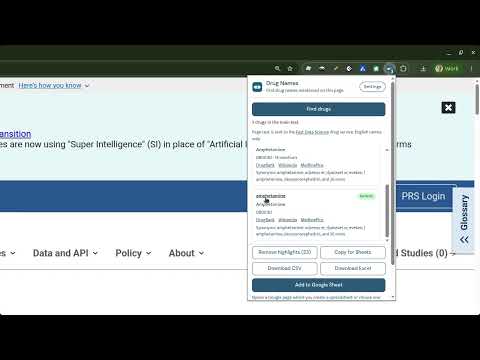
Detect and highlight medicine/drug names on any webpage, view molecular formula and other data, and export to Google Sheets.
Instantly identify medications, molecules, and chemical compounds on any webpage. Drug Data Lookup automatically detects pharmaceutical and chemical names on any page you visit, including PubMed abstracts, ClinicalTrials.gov clinical trial protocols, patents, narrative reports, and medical news, and displays an instant hover card with 2D molecular structures, chemical formulas, and standardised database links. Drug Data Lookup was built by Fast Data Science on top of an open-source biomedical NLP engine cited in peer-reviewed research. You can stop opening ten browser tabs to look up drug structures and database IDs while reading papers! What appears when you hover over a drug? • 2D Molecular Structure Diagram: High-resolution chemical structure rendered immediately on hover or click. • Chemical Properties: Molecular formula, exact molecular weight, SMILES string. • Standardised identifiers & direct links: Jump straight to DrugBank or MeSH • Brand-to-generic resolution: Recognises common brand names, generic names, and international synonyms. Key features include: • Drug name detection: uses Named Entity Recognition (NER) to highlight generic names, brand names, and pharmaceutical compounds across PubMed, ClinicalTrials.gov, Wikipedia, news sites, and PDFs. • 2D molecular structure images: View high-resolution chemical structure diagrams immediately on hover or click. • Essential chemical properties: Instant access to molecular formula, exact molecular weight, and standardized identifiers (DrugBank, MeSH, PubChem, ChEMBL, and NHS codes). • One-Click Export & Copy: Copy SMILES strings, InChI keys, molecular weights, or export all detected drugs on a page to CSV / Google Sheets. • Privacy-First & Lightweight: Runs fast without slowing down your browser or tracking your browsing history. Who is it for? • Clinicians, chemists & pharmacologists • Medical writers, editors & patent analysts • Pharmacy, chemistry & medical students • Clinical researchers & biotech analysts How to use Drug Data Lookup: 1. Install Drug Data Lookup and pin it to your browser toolbar. 2. Visit any webpage containing pharmaceutical or medical text (e.g., a PubMed abstract or clinical trial protocol). 3. Click the extension icon (or toggle auto-highlight) to detect all drug mentions and inspect their molecular structures and formulas. 4. Mouse over the mentions to see a visualisation of the information on each drug. 5. Optionally, you can export the drugs found into a Google Sheet. Privacy and data security: We do not use any AI models, and your data is not stored by us or sent to any third party. Drug Data Lookup is GDPR compliant: Built and maintained in the UK by Fast Data Science Ltd under strict data-protection standards. ICO registration reference: ZB125815 Accompanying Google Sheets add-on: You can use our Google Sheets add-on to enrich lists of drug names within a spreadsheet: https://workspace.google.com/marketplace/app/drug_name_recogniser/463844408236 Underlying open-source Python library: This Google Sheets™ plugin runs on the Drug Named Entity Recognition Python library which is open source under MIT License. Source code is on Github: https://github.com/fastdatascience/drug_named_entity_recognition Citation: Wood, T.A., Drug Named Entity Recognition [Computer software], Version 2.0.9, accessed at https://fastdatascience.com/drug-named-entity-recognition-python-library, Fast Data Science Ltd (2024) Case study #1 - building an annotated corpus of neurological diseases Clinical trial registries (like ClinicalTrials.gov) contain unstructured descriptions of interventions and therapies. Simona E. Doneva at the University of Zurich and her colleagues used the Drug Named Entity Recognition Python library to make an annotated corpus of neurological diseases from raw trial records, in a paper titled "NeuroTrialNER: An Annotated Corpus for Neurological Diseases and Therapies in Clinical Trial Registries".[1] Case study #2 - building an annotated corpus of neurological diseases In longitudinal cohort and gerontological studies, patients self-report their medications in free-text fields—resulting in typos, brand/generic mixing, and inconsistent formatting. Singh et al used the Drug Named Entity Recognition Python library to clean and harmonise these messy patient medication logs into reproducible, structured datasets.[2] Many researchers store survey responses and patient medication logs directly in spreadsheets. Drug Data solves the exact problem of harmonising messy, self-reported medication columns into clean generic names and IDs. Citations of the Drug Named Entity Recognition Python library 1. Doneva, Simona, et al. NeuroTrialNER: An Annotated Corpus for Neurological Diseases and Therapies in Clinical Trial Registries. Proceedings of the 2024 Conference on Empirical Methods in Natural Language Processing. 2024. 2. Singh, Ramkrishna K., et al. Harmonizing self-reported and free text medication data: a reproducible pipeline for gerontological research. BMC Medical Informatics and Decision Making 26.1 (2025): 35. 3. Kim S, Chen J, Cheng T, et al. PubChem 2025 update. Nucleic Acids Res. 2025;53(D1):D1516-D1525. doi:10.1093/nar/gkae1059 4. Knox C, Wilson M, Klinger CM, et al. DrugBank 6.0: the DrugBank Knowledgebase for 2024. Nucleic Acids Res. 2024 Jan 5;52(D1):D1265-D1275. doi: 10.1093/nar/gkad976. 5. Szplit, Dariusz, et al. How to create perfect patient medical records without having to write anything? Adaptive AI platform for processing medical language in Polish. BMJ Open Quality, 2026. 6. Szplit, Dariusz, et al. Developing an AI platform for voice-input medical records in Polish: a digital application for optimisation of physicians’ workload. Scientific Reports (2026). 7. Disharoon, Andrew, et al. InfoMedex: drug-drug interaction prediction via a multimodal CNN-transformer model. Frontiers in Drug Safety and Regulation 6 (2026): 1841035.
0 out of 5No ratings
Details
- Version1.0.7
- UpdatedNovember 21, 2026
- Size674KiB
- LanguagesEnglish (United Kingdom)
- DeveloperFAST DATA SCIENCE LTDWebsite
55 Sotheby Road LONDON N5 2UP GBEmail
thomas@fastdatascience.comPhone
+44 7906 331524 - TraderThis developer has identified itself as a trader per the definition from the European Union and committed to only offer products or services that comply with EU laws.
- D-U-N-S223679516
Privacy

This developer declares that your data is
- Not being sold to third parties, outside of the approved use cases
- Not being used or transferred for purposes that are unrelated to the item's core functionality
- Not being used or transferred to determine creditworthiness or for lending purposes
Support
For help with questions, suggestions, or problems, visit the developer's support site