


Overview
Build a recipe for any brew, espresso to filter. 18 methods, six roast levels and pressure profiling. From Vellutto.eu.
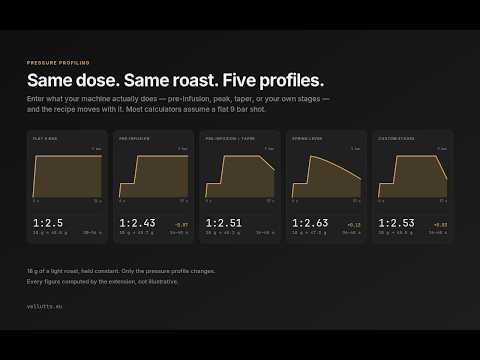
You open a new bag, pull a shot, and it's sour. So you move the grind, change the dose, and half the bag is gone before you find your way back. This gives you the starting point instead. Tell it what you're brewing, how much coffee you're putting in, how dark the roast is, and what your machine does with pressure. Back comes a yield, a ratio, a brew or shot time, a water temperature, and which way to move the grinder. WHY THE RATIO MATTERS Brew ratio is the weight of dry coffee against the weight of liquid in the cup. Espresso is 1:2, so eighteen grams in and thirty-six out. Filter runs far longer, nearer 1:16. That one number does most of the work. Push too little water through the coffee and the cup comes out sour and thin, push too much and it turns bitter and hollow. Most of us carry one recipe across every bag we buy. Then a light Ethiopian tastes sharp on settings that suited a dark Italian blend, and it isn't obvious why. EIGHTEEN METHODS The espresso family covers ristretto and lungo alongside the standard shot. For filter there's the V60, Chemex, generic pour-over, steep-and-release brewers like the Hario Switch, the AeroPress both ways up, batch drip and siphon. Immersion covers the French press, moka pot, Turkish coffee, cold brew and its concentrate. Cupping follows SCA protocol. Each carries a recommended range plus a wider band you can push into when you feel like experimenting, and if you wander outside the range it tells you which direction you went and by how much. ROAST Six levels, light through to extremely dark, with the approximate Agtron range on each swatch. On espresso, roast moves the ratio. Light roasts are dense and don't give up their solids easily, so they pull longer, nearer 1:2.5. Medium sits at 1:2. Dark roasts pull shorter, nearer 1:1.7. On filter it barely moves at all, and we say so rather than inventing a number. Roast is better handled there with grind size and water temperature, so that's what shifts. PRESSURE PROFILING Most brewing calculators assume a flat nine bar shot. This one asks what your machine actually does. Set a pre-infusion pressure and how long it runs, a peak, a taper at the end. Or build the profile stage by stage. Your curve draws itself while you type, and the recipe follows it, so changing eight seconds of pre-infusion to thirty visibly stretches the shelf and shortens the ratio at the same time. The reasoning: a long pre-infusion soaks the puck, so you can grind finer and get the same extraction from less water. A declining finish stops the last few seconds turning harsh, which means a longer pull still tastes clean. Under roughly seven bar you're grinding coarser and need more water to make up for it. Spring levers, flow control paddles and fully programmable machines all work. If yours does none of that, leave it on nine bar. Everything else still applies. WHAT IT WON'T TELL YOU Every number is labelled by how well it's backed up, and it admits when it's extrapolating. Where good sources disagree, it says so instead of picking one and sounding confident. It won't claim profiling makes coffee taste better. What the research actually supports is consistency and fewer channelled shots, which is a smaller promise than the marketing usually makes and a truer one. No profile rescues a bad puck or stale beans. If your roaster prints a recipe on the bag, use theirs. Ours is a place to start. Powered by Vellutto.eu, who built it and keep it running.
0 out of 5No ratings
Details
- Version1.1.0
- UpdatedAugust 27, 2026
- Size45.77KiB
- LanguagesEnglish
- Developer
- TraderThis developer has identified itself as a trader per the definition from the European Union and committed to only offer products or services that comply with EU laws.
- D-U-N-S473581884
Privacy

This developer declares that your data is
- Not being sold to third parties, outside of the approved use cases
- Not being used or transferred for purposes that are unrelated to the item's core functionality
- Not being used or transferred to determine creditworthiness or for lending purposes
Support
For help with questions, suggestions, or problems, visit the developer's support site