

LitRank: Journal Quartiles on Google Scholar

Overview
Journal quartiles, SJR, h-index and open access on Google Scholar. Citation manager: filter by rank, save, export BibTeX. Free.
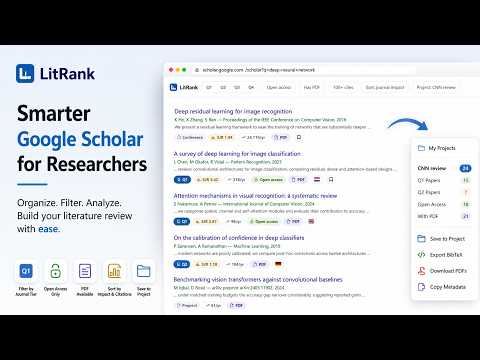
Google Scholar tells you how many times a paper was cited. It does not tell you anything about where it was published. LitRank fixes that. Every result gets a badge showing its journal quartile — Q1, Q2, Q3 or Q4 — along with the journal's SJR score, whether it is open access, which country it is published in, and how many citations it earns per year. Then you can filter the page by any of it. Free, and free forever. No account. No tracking. Works offline. ──────────────────────────── WHAT YOU SEE ON EVERY RESULT ──────────────────────────── • Quartile badge — Q1 through Q4, colour-coded • SJR score and h-index, with the subject-category breakdown on hover • Open access and DOAJ indicators • Country of publication, as a flag • Citations per year — because a 2004 paper with 400 citations is not outperforming a 2023 paper with 90 • Document type — journal article, conference paper, book chapter, preprint, thesis or report ────────────────────────────────── FILTERS GOOGLE SCHOLAR DOES NOT HAVE ────────────────────────────────── • Quartile — show only Q1 and Q2 work • Minimum citations — Scholar sorts by citations but cannot filter by them • Document type — exclude preprints, or show only journal articles • Open access only — skip what you cannot read • PDF available — only results with a direct PDF link • Hide already-saved — on a second pass, see only what you have not triaged • Sort by journal impact or by citations, without losing Scholar's own order • Load more results in place, instead of clicking through pages ───────────────── RESEARCH PROJECTS ───────────────── A literature search is not one list. LitRank lets you keep several. • Save any result into a named project with its own icon, colour and description • One paper can belong to several projects — no duplicates, no split metadata • Per-project statistics: quartile distribution, median SJR, publication-year histogram, and the venues you are actually citing • Export BibTeX, CSV or JSON — ready for Zotero, Mendeley or EndNote • Fetch full metadata from Crossref to fill in volume, issue and pages • Sync a project to a folder on your computer, or batch-download the PDFs you have access to ────────────── WHERE IT WORKS ────────────── Google Scholar search results, author profiles and Scholar Labs — across 30+ country domains, from scholar.google.com to scholar.google.co.in. ──────────────────────────── IT SHOWS NOTHING RATHER THAN GUESS ──────────────────────────── Scholar abbreviates and truncates venue names. LitRank resolves them against ranking data carried inside the extension — but where more than one journal could fit, it shows no badge at all. An "Unranked" badge means the venue was not matched. It never means the venue scored badly. A tool that quietly guesses is worse than one that admits the gap, because from the outside you cannot tell the two apart. ─────── PRIVACY ─────── LitRank has no server. There is no account, no sync service and no analytics. • The ranking data ships inside the extension and is read on your machine • Saved papers live in your browser's local storage • No telemetry, no tracking, no advertising, no data sale • The only outbound request is to Crossref, and only when you press "Fetch metadata" Nothing you search for or read is transmitted anywhere. We could not see your reading list if we wanted to. ────────────────────────── FREQUENTLY ASKED QUESTIONS ────────────────────────── Q: Does LitRank show the Journal Impact Factor? A: No. It shows SJR quartiles — a different metric, on a different scale, from a different provider. Journal Impact Factor is a Clarivate metric published in Journal Citation Reports and cannot be redistributed in a free extension. If you need JIF specifically, LitRank is not what you want. Q: Why does a paper show "Unranked"? A: Because the venue could not be matched with confidence — not because it scored badly. Usually the venue is not a journal at all (preprints, theses and book chapters carry no quartile), or Scholar truncated the name past the point where it is still unique. The badge tells you which. Q: Why do conference papers have no quartile? A: Quartiles are assigned to journals, not to proceedings. Rather than invent a rank, LitRank shows the conference's SJR score and h-index instead. Q: Does it work on author profiles? A: Yes. Profile pages get the same per-publication badges, plus a summary of the loaded publications — how many are Q1, the median SJR, and the spread across quartiles. One square per paper, so you are counting rather than estimating. Q: Does it slow Google Scholar down? A: No. The ranking data is prepared once per page, off the critical path, and every lookup after that is instant. Q: Is my reading list stored in the cloud? A: No. Everything stays in your browser. You can export it or sync it to a folder on your own computer at any time, but nothing leaves your machine unless you ask it to. Q: Can I use it with Zotero, Mendeley or EndNote? A: Yes. Export BibTeX from any project and import it. Records carry a DOI wherever one could be recovered, so your reference manager can fill in anything Scholar did not show. Q: Will it stay free? A: Yes. There is no paid tier and none is planned. Q: Is LitRank affiliated with Google? A: No. LitRank is an independent extension. Google Scholar is a trademark of Google LLC. Journal Impact Factor and Journal Citation Reports are trademarks of Clarivate. Scopus is a trademark of Elsevier B.V. ─────── SUPPORT ─────── Found a bug, or a journal that should be ranked and is not? Open an issue and tell us the venue name exactly as Google Scholar prints it — that string is what the matcher has to work with. https://github.com/riponcm/LitRank/issues
5 out of 51 rating
Details
- Version1.6.0
- UpdatedAugust 9, 2026
- Size1.9MiB
- LanguagesEnglish (United States)
- DeveloperWebsite
Email
support@matily.org - Non-traderThis developer has not identified itself as a trader. For consumers in the European Union, please note that consumer rights do not apply to contracts between you and this developer.
Privacy

This developer declares that your data is
- Not being sold to third parties, outside of the approved use cases
- Not being used or transferred for purposes that are unrelated to the item's core functionality
- Not being used or transferred to determine creditworthiness or for lending purposes
Support
For help with questions, suggestions, or problems, visit the developer's support site