

AddressHate Annotator
6 ratings
)
Overview
Annotate posts on social media and AI chat sites without leaving the page. Made for labs and research institutions.
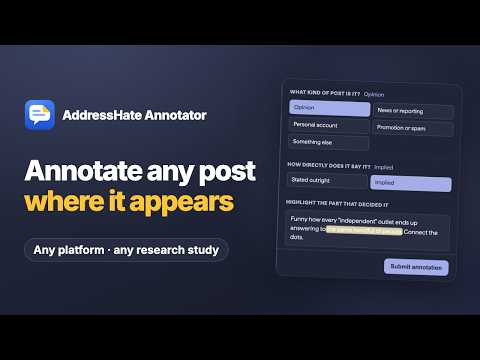
AddressHate Annotator is a research tool for annotating online content where it appears. It adds an Annotate button to posts, comments, videos and AI chat replies, so you can code them against your study's codebook on the page where you found them. Your work then goes to your team's workspace for review. It fits any study of online content: public discourse, misinformation, health communication, hate speech, or whatever your codebook asks about. Your team writes the questions; the extension asks them. You need an AddressHate account to use it. Anyone can sign up and report content. Annotating for a study requires access from the team running it, either through an invitation or by requesting to join with an academic email address. You can sign in with a work or school account, or with a password. GETTING STARTED 1. Install the extension and pin it to your toolbar. 2. Sign in, or create an account and confirm your email. 3. Go to a supported site, hover over a post and click Annotate (or press Alt+A). 4. Fill in your study's questions and submit. A lead on your team will review it. WHERE IT RUNS The extension turns on by itself only on the social media and AI chat sites it supports. The full list is under site access on this page. Everywhere else it stays off until you open it from the toolbar or with a keyboard shortcut, and even then it only works in that tab. It doesn't read or send anything from a page you haven't opened it on. FEATURES • Annotate in place. Record ratings, categories, notes and free text, highlight the passage you're coding, and attach nearby replies when a post needs context. • No duplicate work. Posts your team has already covered are marked. • Custom codebooks. Leads build question sets in the browser, including follow-up questions that only appear when relevant, and can apply one to the whole organization or a single project. Each answer is saved with the version of the codebook it was given under, so editing a question later won't change earlier data. • Projects and assignments. Organize work into projects and sub-projects, assign links to specific annotators, and work through each queue from the extension's workspace. • Review. Leads approve each submission or send it back with a note. When two annotators disagree, a side-by-side view shows both answers so the team can settle it. • Agreement. Inter-rater agreement statistics for every project, computed from the answers as they come in. • Export. Download a spreadsheet with one column per question, filled in with the answer text rather than codes. You can also export structured data, schedule regular delivery to a mailbox or storage bucket, or give a script read-only access with a key that a lead can revoke. • Accessibility. The interface is built to WCAG 2.1 AA and can be used entirely by keyboard. Accessibility tests run on every build. PRIVACY When you install or remove the extension, it opens our welcome or goodbye page with a random install ID that carries no personal information. Otherwise, nothing is sent until you're signed in and annotate or report something. The extension doesn't collect or log the pages you browse, and your research data is stored only on the project's own service. Two features share data with outside services: • AI second opinion. If you ask for one, the text of that post goes to the AI provider the project uses. Your account details are not included. • Mailing list. When you set up your account, there's an optional box to join the AddressHate mailing list, which runs on a newsletter service. It's unticked by default. If you tick it, your email address, name and organization are shared with that service, and you can unsubscribe from any email. AI chat conversations are private, so a link alone won't show a reviewer anything. When you report an AI reply, the extension includes the reply, the prompt that produced it and a few earlier turns. You'll see all of it before it's sent and can remove the earlier turns. If you cancel, nothing is sent. Annotating an AI reply also saves the reply with the turns before it. Your team's reviewers can see the prompt. No one else can open the conversation. The Privacy Policy and Data Deletion pages linked on this listing explain what we keep, why, and how to have it deleted. ABOUT ADDRESSHATE AddressHate is a non-profit research project. We built this tool to measure and document online hate speech, and we offer it to any lab that studies online content. It is not meant for creating or spreading hateful material. For help, visit https://api.address-hate-dashboard.org/support
5 out of 56 ratings
Details
- Version1.0.9
- UpdatedOctober 22, 2026
- Offered byAddressHate
- Size1.48MiB
- LanguagesEnglish (United States)
- DeveloperAddressHate, Inc.
152 W 57th St 21st floor New York, NY 10019-3386 USEmail
ksaiki@addresshate.org - Non-traderThis developer has not identified itself as a trader. For consumers in the European Union, please note that consumer rights do not apply to contracts between you and this developer.
Privacy

AddressHate Annotator has disclosed the following information regarding the collection and usage of your data. More detailed information can be found in the developer's privacy policy.
AddressHate Annotator handles the following:
This developer declares that your data is
- Not being sold to third parties, outside of the approved use cases
- Not being used or transferred for purposes that are unrelated to the item's core functionality
- Not being used or transferred to determine creditworthiness or for lending purposes
Support
For help with questions, suggestions, or problems, visit the developer's support site